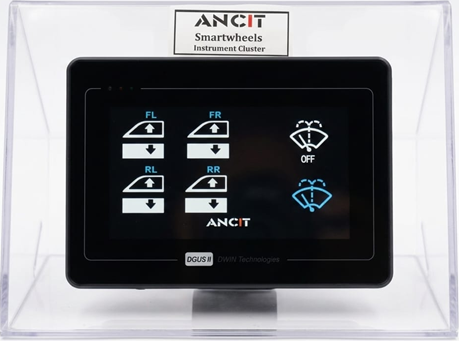
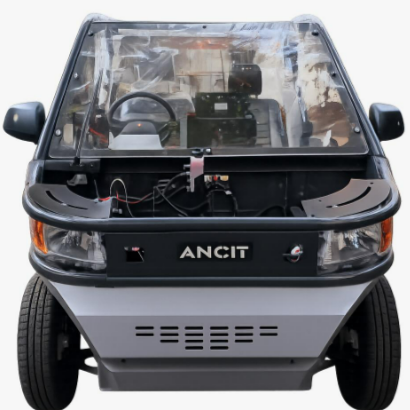
A complete, progressive 6-stage ecosystem — from your first ECU evaluation board all the way to a full drivable test vehicle — purpose-built to transform how universities train engineers and how companies prototype, validate, and showcase automotive software capabilities.
Progression Ladder
Each stage builds on the previous — incremental investment, continuous skill-up
Modern vehicles are no longer primarily mechanical products — they are software platforms on wheels. Features like FOTA, zonal ECU architectures, AUTOSAR-based stacks, and CAN/LIN/Ethernet networks require engineers who have worked on real hardware, real protocols, and real systems. A paper degree or simulation-only curriculum leaves a critical gap.
Each stage is independently deployable. Universities and companies can start at any level and scale up over time. Every stage connects to the next.
SmartWheels Micro EV3 Evaluation Board
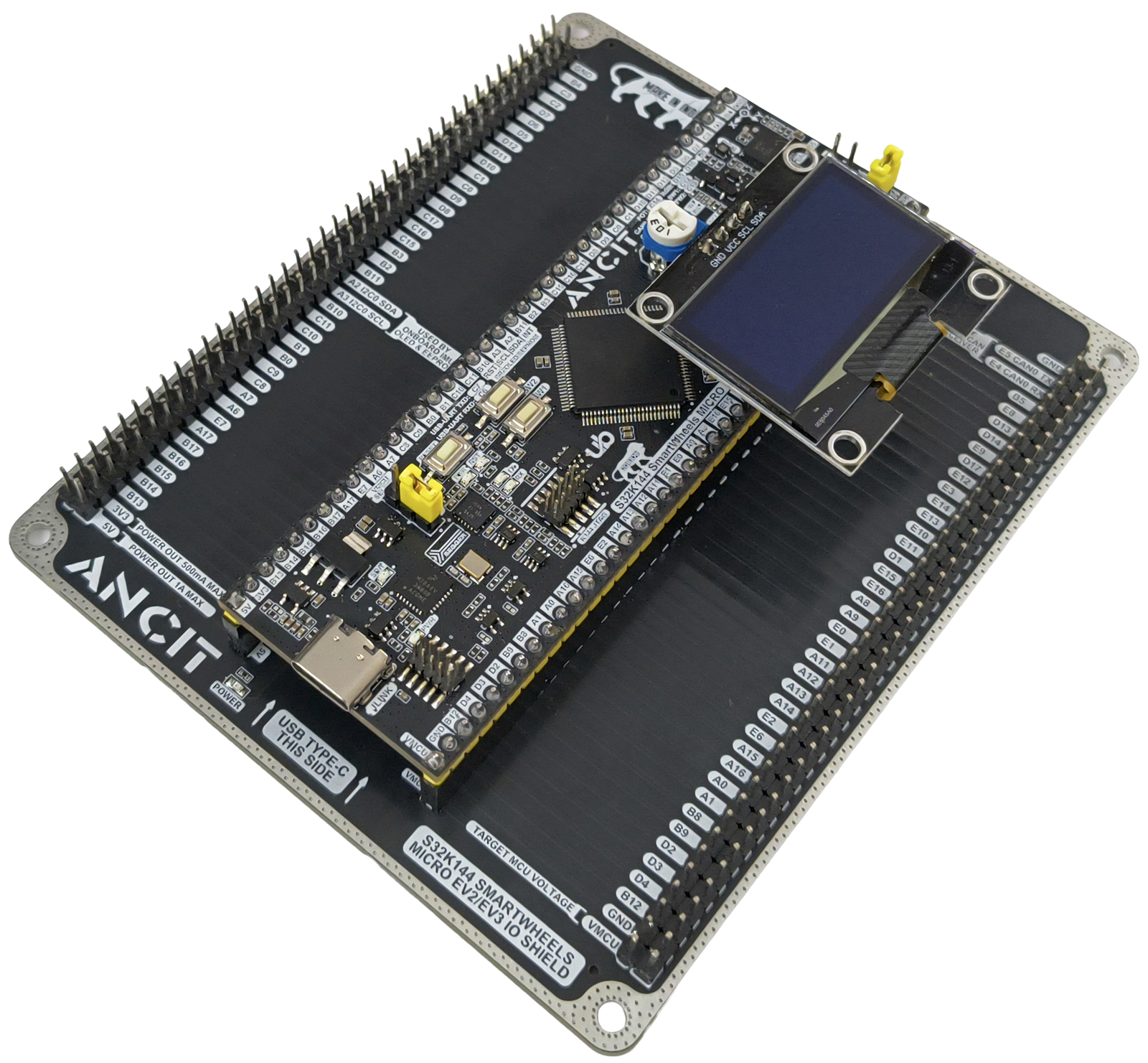
First contact with a real ECU hardware platform. Students write embedded C, wire sensors and actuators, configure CAN/LIN communication, and transmit their first live CAN message — building a foundation in automotive electronics from scratch.
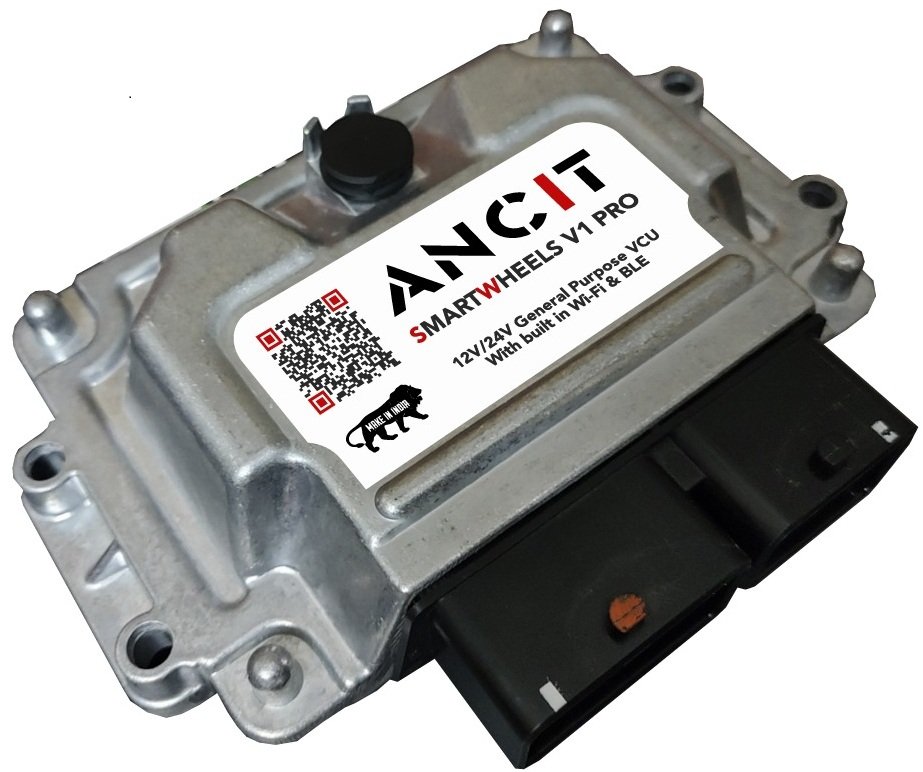
SmartWheels V1 Pro — SIL Platform
Step up to a professional-grade 80-pin automotive ECU. Replicate real OEM ECU architectures — configure signals, tasks, and diagnostics using GenX's zero-code platform, and generate production-ready C or AUTOSAR code from the same GUI.
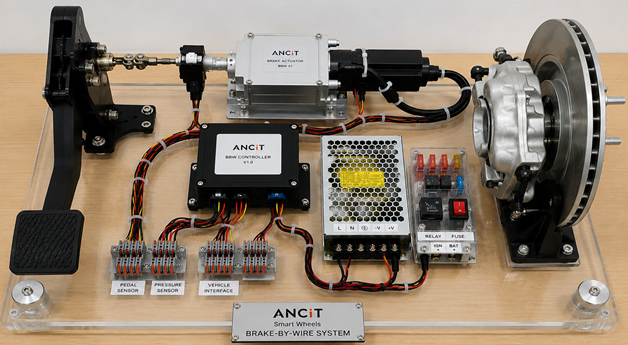
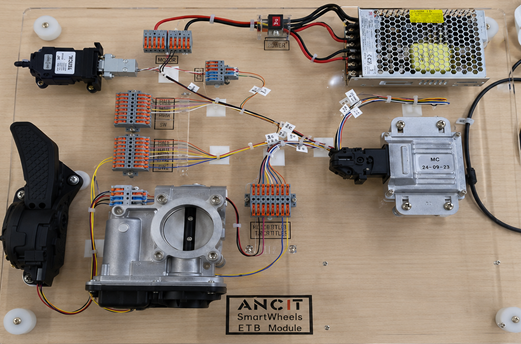
Programmable Vehicle Subsystem Kits — HIL
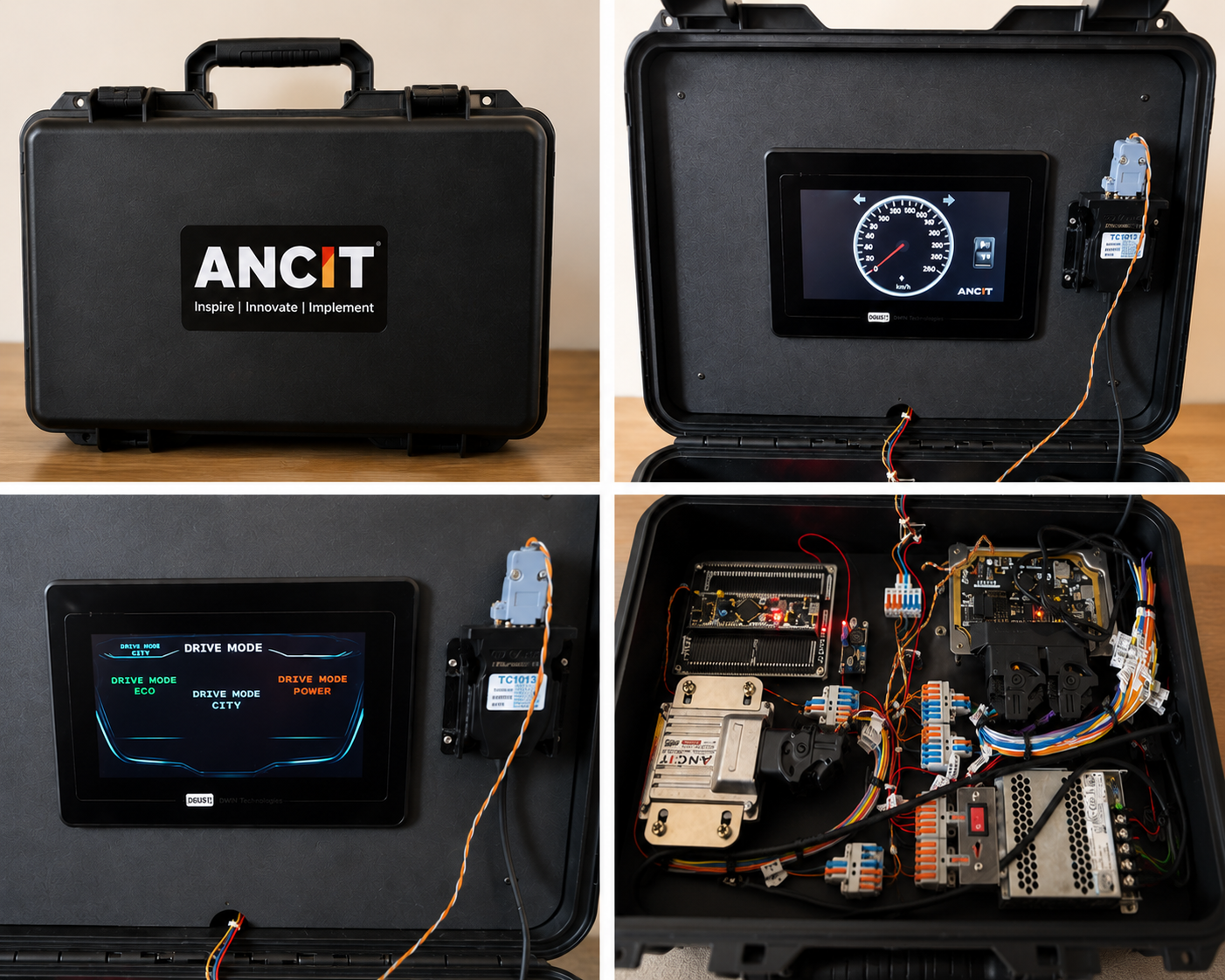
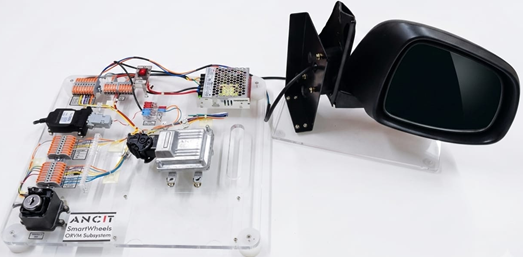
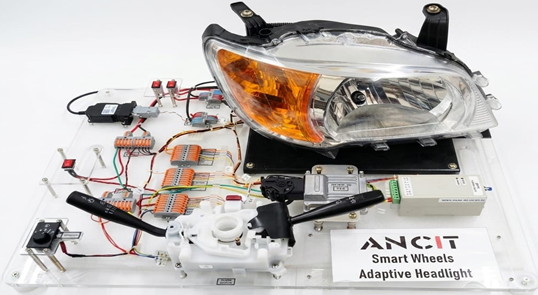
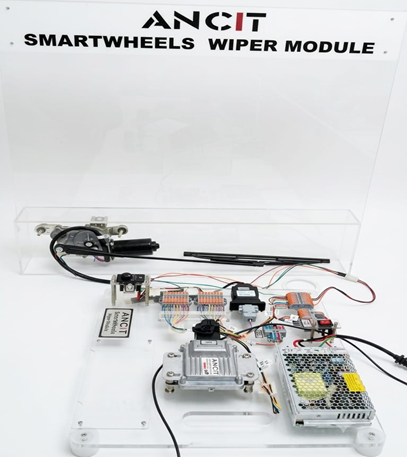
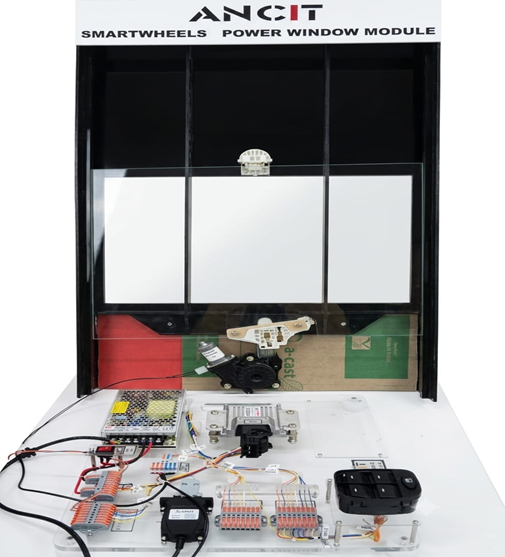
Real vehicle subsystems on the bench. 8 plug-and-play kits (BBW, SBW, ETB, ORVM, Headlights, Wiper, Power Windows, Instrument Cluster) operate on a live CAN network — students write ECU software that controls real actuators and reads real sensors.
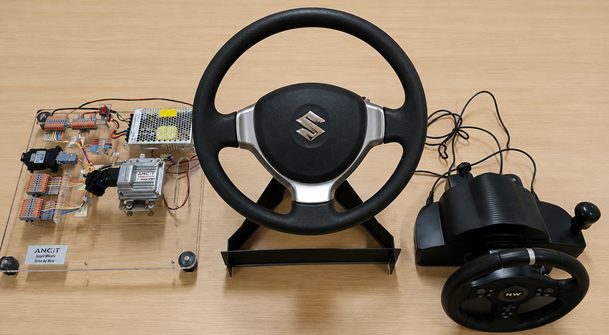
SmartWheels Digital Cockpit — DiL Platform
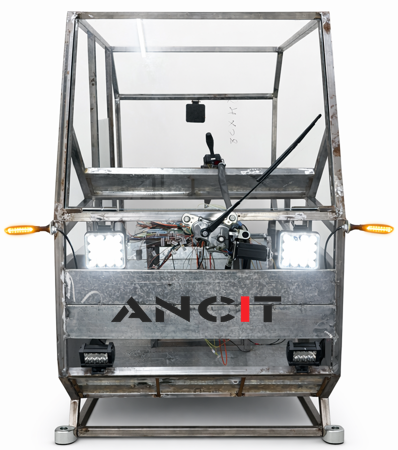
Integrate all Stage 3 subsystems into a stationary vehicle body with a real cockpit. Layer in FOTA, SDV orchestration, zonal gateway ECU logic, and CARLA-based driving scenario simulation. The lab becomes a complete BCM + ADAS test environment.
ANCIT Drivable Test Vehicle
Take everything developed in Stages 1–4 and deploy it onto a road-capable electric vehicle. High-voltage powertrain + low-voltage BCM systems operate together on a live dual-CAN network — exactly how a production EV works.
GenX + SmartWheels AR — Production Grade
The production-engineering capstone. Apply Model-Based Systems Engineering (MBSE) using MATLAB/Simulink, generate AUTOSAR ICC1-compliant code from GenX, and configure SWC/RTE/COM stacks using SmartWheels AR — the same workflow used by global Tier-1 suppliers.
Every package is independently complete. Start at any level — scale up as your lab and team grow.
The ANCIT SDV CoE is not one-size-fits-all. Each audience gets a tailored implementation path.
Enabling the next generation of automotive software engineers
Stage 1–2 for core embedded courses; Stages 3–4 for final-year projects; Stages 5–6 for M.Tech/PhD research. Every stage maps to course outcomes in embedded systems, automotive engineering, or EV technology.
Students work on actual ECU hardware, real CAN buses, and real actuators — not just MATLAB models. The gap between classroom theory and industry expectation closes completely.
Graduates from CoE labs have written UDS diagnostic services, configured AUTOSAR stacks, and flashed ECUs over CAN — skills that OEMs and Tier-1s actively hire for. Placement outcomes improve measurably.
The Drivable Test Vehicle (Stage 5) is a natural home for SAE, Baja, or EV club projects — students can instrument a real vehicle and run ADAS algorithms in the field.
The open programmable architecture lets OEM and Tier-1 partners bring real problems into the lab — sponsored capstone projects, contract research, and joint IP development all become straightforward.
Showcase capabilities and accelerate software-first vehicle development
The Digital Cockpit (Stage 4) and Drivable Test Vehicle (Stage 5) form a compelling, walkable demo of your team's software integration capability — far more impactful than slides in a boardroom.
Engineers experienced in legacy ECU development can progress through the same 6 stages and build hands-on fluency with AUTOSAR, FOTA, zonal architectures, and CARLA simulation — without leaving the office.
New ADAS features, SDV services, or powertrain algorithms can be prototyped on Stage 3 subsystems or the Stage 5 drivable vehicle in weeks — not the months required to modify a production test bench.
The open GenX + SmartWheels AR stack lets teams evaluate AUTOSAR BSW configurations on real hardware before committing to expensive commercial toolchain licences.
Integration testing, toolchain validation, and customer demonstrations
Stages 3–4 combined form a complete multi-node CAN integration bench where your middleware, diagnostic stack, or gateway software can be tested against real subsystem ECUs, not stubs.
Every ANCIT ECU is reprogrammable and ships with documented communication interfaces. Integrators can load their own application layer on top of the SmartWheels hardware and validate against a known-good reference stack.
The full CoE supports demonstration of an end-to-end FOTA pipeline: server → gateway ECU → subsystem ECU flash over CAN — a compelling proof for automotive cloud service providers.
SmartWheels AR generates tool-agnostic ARXML. Integrators can validate their BSW vendor's toolchain against ANCIT-generated ARXML before deploying to customer vehicles — reducing integration risk.
The electronics architecture of a modern EV, an off-road AGV, a hyperloop pod, or an eVTOL share the same core building blocks — CAN, embedded MCUs, AUTOSAR, and safety-critical ECU design. The ANCIT CoE trains for all of them.
Passenger cars, commercial trucks, two-wheelers, and micro-mobility platforms. All Stage 1–6 competencies apply directly to production automotive software development.
Agricultural vehicles, mining equipment, construction machinery, and autonomous ground vehicles (AGVs) all require the same ECU-over-CAN architecture — without road regulations simplifying validation.
Hyperloop pods, maglev systems, and high-speed rail demand fault-tolerant ECU architectures, redundant CAN networks, and safety-critical AUTOSAR stacks — precisely what Stages 4–6 build expertise in.
Electric vertical takeoff and landing aircraft require distributed ECUs, power management controllers, and CAN/Ethernet networks — in an environment where weight, latency, and failure tolerance are non-negotiable. The AUTOSAR and MBSE skills from Stage 6 are directly transferable.
The common thread across all domains
CAN / LIN communication · AUTOSAR BSW · UDS diagnostics · embedded C on automotive MCUs · functional safety design. Master these in the CoE and you're prepared for any mobility platform.
Every stage uses physical ECUs, real CAN buses, real actuators, and a real drivable vehicle. Simulation has its place in Stage 4 (CARLA), but never replaces hands-on hardware learning.
GenX generates both bare-metal C and AUTOSAR ICC1 code from the same GUI. Students learn one tool and can target both stacks — unlike commercial solutions that require two separate platforms.
All ANCIT ECUs are open to reprogramming. There are no locked firmware black boxes. Universities can write their own BSW, companies can load proprietary application layers — the hardware is always transparent.
Start with Stage 1 (EV3 board) at minimal cost and add stages as budget and curriculum mature. Each stage delivers standalone value and connects forward — no sunk-cost trap of an all-or-nothing lab purchase.
All ANCIT products are designed, manufactured, and supported in India. Pricing reflects a social commitment to democratising automotive toolchains for students, researchers, and startups across the country.
From the entry-level eval board to the drivable test vehicle, every component is designed by ANCIT. No integration headaches from stitching together products from five different vendors — one partner, one support line.
Whether you're a university building a lab for 50 students or an OEM equipping an R&D team — we'll help you design the right stage mix, configure the hardware, and get your team up and running fast.
info@ancitconsulting.com · +91 97989 48413 · ancitconsulting.com