A complete multi-ECU vehicle network — packed inside a rugged carry case. Every ANCIT hardware product, pre-wired and ready to demonstrate automotive software on two independent CAN buses, anywhere in the world.
Private In-Vehicle CAN | OBD / Public Access CAN | DWIN Instrument Cluster | Drive Mode Control
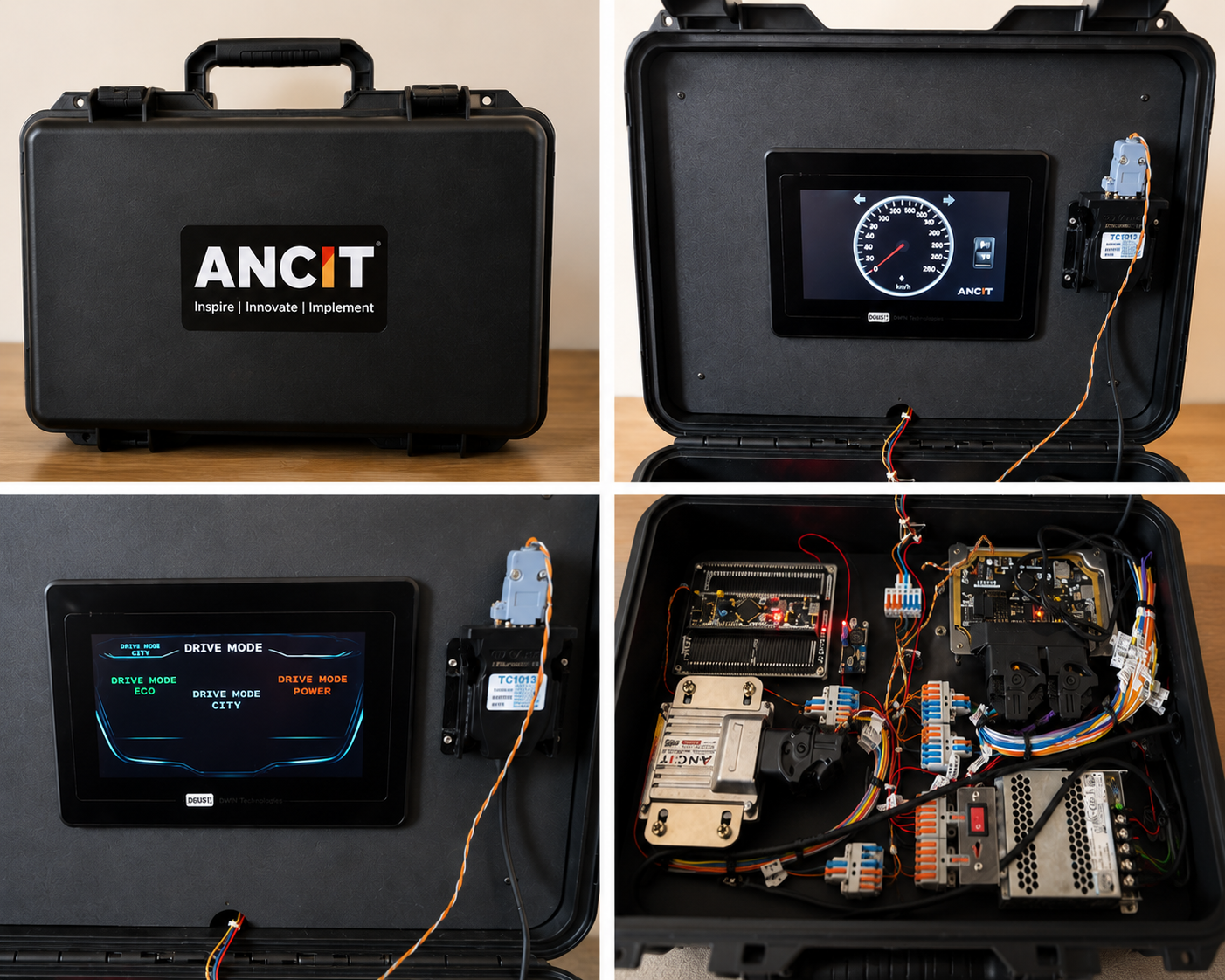
SmartWheels 80-pin ECU · SmartWheels Mini ECUs · DWIN Display · Gateway · Power Supply — all in one case
CAR in a Box — live demo of the multi-ECU network and instrument cluster.
Dual CAN bus · DWIN Instrument Cluster · Drive Mode switching · Live ECU network
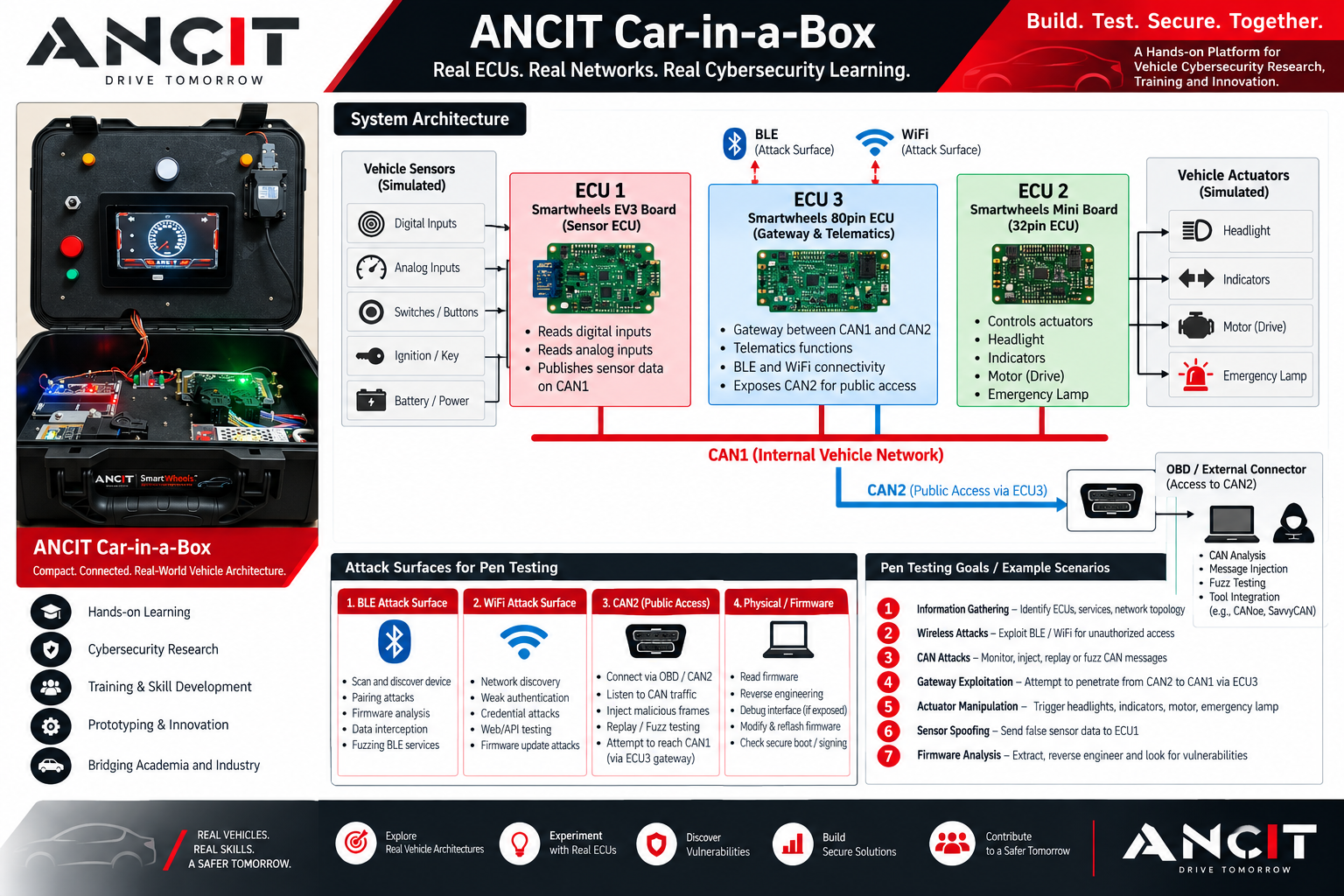
Just like a real vehicle — two isolated networks with distinct roles.
Three ECUs. Two CAN buses. Four attack surfaces — a complete real-vehicle topology in one case.
Reads digital inputs, analog sensors, switches, and ignition — publishing all simulated vehicle sensor data onto CAN1 (the private internal network). Acts as the physical-layer bridge between the real world and the vehicle network.
The central gateway — bridges CAN1 to CAN2, hosts BLE and Wi-Fi (both modelled as attack surfaces), handles telematics functions, and exposes CAN2 via the external OBD connector. This is where gateway exploitation and wireless pen testing scenarios originate.
Controls all simulated body actuators — Headlight, Indicators, Drive Motor, and Emergency Lamp — responding to CAN1 commands. Ideal for demonstrating actuator manipulation scenarios and verifying end-to-end CAN messaging from sensor to actuator.
CAR in a Box exposes four realistic attack vectors: BLE (scan, pair, fuzz, intercept), Wi-Fi (network discovery, credential attacks, API testing), CAN2 via OBD (frame injection, replay, fuzzing, gateway penetration), and Physical / Firmware (read, reverse-engineer, re-flash). Seven pen testing goals — from information gathering through actuator manipulation to firmware extraction — can be executed without touching a real vehicle.
Every ANCIT hardware product, pre-integrated and pre-wired.
The primary domain controller running vehicle-level software, CAN gateway logic, and AUTOSAR stack. Central node on the private CAN bus.
View ProductMultiple Mini ECU nodes handling body control functions — ORVM, Headlight, Wiper, and Power Windows — all communicating on the private CAN bus.
View ProductHigh-brightness DWIN display mounted in the case lid, showing real-time speed, drive mode (ECO / CITY / POWER), and vehicle state — driven by CAN data.
View SubsystemIsolates and bridges the two CAN buses. Routes selected diagnostic messages from the private network to the OBD bus, mimicking a real gateway ECU architecture.
Clean 12 V automotive-grade power rail with switch and fuse block — powers all ECUs and the display from a single mains input. No bench PSU needed.
External OBD-II connector on the case edge. Plug in a TOSUN dongle, TS Master, or VxDiag tool for live diagnostics, ECU flashing, or IDS testing — no internal wiring access needed.
TS Master ToolThe SmartWheels EV3 evaluation board acts as a hands-on I/O and sensor interface kit — connect real-world sensors, actuators, and switches directly to the CAN network inside the box.
View EV3 BoardIP-rated hard shell case — carry it to a college lab, customer site, or trade show. Fits in aircraft overhead bins.
One power cable in. Everything else is pre-wired and pre-configured. Boot to live CAN traffic in under 60 seconds.
Every ECU runs ANCIT SmartWheels firmware — reflash any node using GenX (no-code) or custom C / AUTOSAR code via the OBD port.
The dual-bus architecture is the ideal testbed for IDS (Intrusion Detection) and secure diagnostic flows using the ANCIT IDS stack.
CAR in a Box works out-of-the-box with the entire ANCIT software stack.
Designed for universities, R&D labs, OEMs, and system integrators who need real automotive hardware — without a real vehicle.